The sixty degree crossing from Bertram Heyn has arrived. Back in February I talked about the Trouble with gardens and curves and the need for a piece of track that only he makes to be able to link up four LGB R1 points. (Browsing through the PIKO catalogue/brochure I see that they envisage making one.... sometime....).
One think that I wasn't aware of was its DCC use and electrical isolation. So, its out with some track, and testing locomotive (Red Schoema again - I wonder if is prophetic that it arrived with DCC ID number 13 and I've not changed it).
So, we have the test run and no stalling over the connection and electrical independence was there, since when I placed it on the unconnected tracks then there was no power.
There is a slight downside though - the straight bits to fit between the points are 125mm long (I asked Bertram Heyn). This size of track is not a standard LGB size but is available from Herr Heyn. So, I guess its time for some more shopping.....
I also played around with what I propose to do (see the earlier track plan) at the bottom end due to the way the garden path and flowerbeds are. In my earlier plan I used R3 point, whereas in this example I used the R1.
A couple of years ago when I started the G scale stuff then one of the plans was the logging layout with a Shay (the "bendy train"). That soon faded upon discovering the cost of G scale shays made by Bachmann (LGB have done some as well I believe but only brass and in partnership, so they are even more expensive) were £800+, and that the circuit boards would need to be ripped out before going anywhere near LGB stuff as LGB operates at 24 volts and the Bachmann circuit boards were designed for 10 volts. If I knew then what I know now, then I should probably have bought a Bachmann Shay from G scale online and had the circuit boards ripped out. I keep looking at the Bachmann On30 stuff and thinking it would be nice to see some of the shays in the large scale.
The very first thing was the Schlitz Beer reefer LGB, and the ATSF caboose from a starter set (but no chimneys - so I wonder if they came from the demise of LGB). First locomotive was a PIKO 0-6-0 Switcher at a bargain price as some of the detailing was broken. My thoughts were to spry it blue as I liked the Darjeeling B class that was doing the rounds at that point. Management decided that they liked the black look of it though when it did Christmas tree duty in 2011. Then an LGB Porter (DCC chipped, but no sound) at a bargain price from an estate sale. And then the Cabooses.. The idea started to become that the American stuff could be played with by those who wanted to "play trains" on visits, keeping the European stuff for those who would value it.
By dint of buying stuff off ebay and cheap sales, then I've ended up with ATSF, Rio Grande and Union Pacific although there are places where they have running rights and could meet. For a long while the ATSF had two (nice) Red Cabooses but no locomotive. I'd like an LGB Forney but they never seem to go particularly cheap.
Last week I won an LGB ATSF 2-4-0 probably liberated from a starter set. I'd been put off by the pictures which always made it look a bit oddly proportioned but it arrived today, and I must that I think its rather a sweetie. It's also my first tender locomotive (again I would like a blue LGB Nicki Frank S but can't justify, or really afford the £600-£800). Bargain price felt, although I still hadn't seen one at a show. Not chipped - but DCC ready. I've done a short video to show off the valve gear - the ambient lighting is very poor, and my quick attempts to edit in i-movie have done some improvement to show off the valve gear but the actual engine is now quite poor.
The lights work, and wheels and skates would suggest little use.
And to finish, a couple of pictures of it posed with the PIKO 0-6-0, and an LGB 0-4-0 Porter.
OK, so last year was a bit of a washout on the progress front.
I'm determined this year to make some progress to enable the situation where I can come home on a balmy summer evening, connect all the wires up, and with a "toot" be off....
As part of that, then today I have just ordered a particular piece of track from Bertram Heyn which has a specific place within what I'm intending to do, and if works OK I can see me getting a couple more.
It's a simple X piece of track - but one which LGB don't make.
(Pictures are unashemedly borrowed from Bertram's site).
It's usefulness is the ability to end up with this, using four R1 points...
Which I estimate will have a width not exceeding one of my decking boards.
As always, with brand new things its not especially cheap, but there's no LGB alternative (the double slip is probably too shallow.
Looking forward to getting this, and report on how it works with LGB will follow.
I'd mentioned in my 2013 a brief update that I'd been doing infrastructure of various forms, one part of which was the rolling road. Well, they finally arrived and very useful they are too...
Friday saw the collection of the latest upgrade/addition although the twin had been done before Christmas. The is the LGB Spremberger loco, which seems to have been a staple of starter sets (and digital starter sets) for many years now, despite the original currently believed to be rusting away in a warehouse in France.
I quite like the industrial, squat shortness of the design compared with the Stainz.
The original ran on the Spremburger Stadtbahn
There's some modern pictures of the Stadtbahn here:
The loco was factory chipped by LGB but no sound. With the original currently awaiting restoration then there is no dedicated chip and to get away from tthe Stainz and small loco, it was fitted with Massoth 8210120 which is the HSB Fiffi and Pfiffi
LGB do a model of this (e.g. number 22801) which is a 2-6-0 in real life.
Here's a vido of the real Pfiffi in action on the Harz. As I'm unlikey to model the Harz in a "realism" sense, then its doubtful that I will ever own one of the LGB models. The LGB Harz and Rhb stuff that I've seen often has a higher build quality and detail than some other items, presumably because of the demand from collectors and hobbyists.
The end result is a definate throaty "chuff" sound which I think suits the square and squat Spremberger very well. The nameplates and renubmering need to be fixed, but that is another blog post as they say.
It is a bridge I suspect that all model railway people face - the chasm of the rivet counter, when historical accuracy or true to life realism says no to a purchase or running trains. Problem is that some people can become so obsessive that its almost like - OK so my model railway represents October 14th 1962 (which whilst a random date I've just made up had some pretty important things happen on it) because look at the photos on the newspapers in the shop... etc...
I had one of those moments this morning but I think I'm still safely in the land of the non rivet counter.
Last year I got my first (and so far only) double motor locomotive - the Austrian 2095. This is a nice, red, diesel that will happily push the snowplow around the garden (although yet to try with actual snow, but it had enough oomph to cope with the brick in the cart). I like it because of its compactness (length is only 460mm) and lack of protruding parts, nooks and crannies were it to face actual snow....
After some research this morning I established that mine has the generic LGB European Diesel sound card.
It has the running number 205.06. There were 15 of these locos made for Austrian narrow gauge lines.
LGB have made the locomotive with a number of running numbers. So today, we have on eBay another 2095, already fitted with a Massoth digital sound card but in the red/cream earlier livery of Austrian railways and the "eagle" motif at the front.
And with an hour left there are still no bids on it. The starting price is reasonable and realistic - at £300, then a Massoth chip is £175-£200 ish new, meaning only £100+ for the loco. Double heading would mean 4 motors vs the evil snow and immense pulling power. However, it shares the same running number - 2095.06- which means is replicates the same real life loco in an earlier livery.
Do I need it desperately? No!
Would I like it? Yes!
Finally, with a few minutes to go, someone puts a bid in on it.
Ultimately I decide not to bid because of the running number issue and because I could also use £300 towards the Dollnitz Diesel fund. Put the two side by side and once aware of it, then my eye, and I think those of a number of my friends would be drawn to spot the similarity. And I know that there are other running numbers out there and which will presumably crop up at some time in the future.
A friend enquired if I went last - when I didn't know about the show - and the link to a report by Mick's Roving Reporter blogspot and the excellent Photo report. 2012 was the 20th Anniversary and I think that lots of stops had been pulled out to make it an excellent anniversary show. This year seemed to be not quite such good overall quality and quantity to judge from the photo report, but the show is a victim of its own success and was quite busy, making good viewing difficult. I suspect Mick the roving reporter had some sort of press pass to get his photo report without lots of people in the way.
That said, I came away with some ideas for inspiration and eye candy, which is the whole point of going. I managed not to spend too much - although could have handed more over to Steve at Back to Bay 6 but was restrained.
In no particular order we have...
Barton Ings Railway - a little tile and pipe industrial railway. I'm certain I've seen this in the magazaines a while ago, and it is clearly G scale. As with everything at the show it was lovingly modelled with those little bits of detail that mark the great out from the good. What particular piece of inspiration I took away from this layout though was the drive through Engine shed - apparently there in the prototype. This will break up a stretch of flat track/siding out int he garden and is something that I can model given my level of skills.
What I think is the G scale national touring layout was there - I've seen it in similar style at the Warwick Show last year. Few different side details (no skiers for example) but the locos and rolling stock looked very similar.
The South West (aka Bristol and Gloucester) G scale group was there with a little (automated ?) Tram layout. The first picture shows the overall figure of 8 whilst the second has the particular ideas that I shall probably be "borrowing". Expand the picture and you can see the string of "fairly lights" strung between poles, with simple slots cut in tubes to take the wire. My experience of real life Germany is that at outdoor bars etc then they go in for this bright light atmosphere. The second one is the simple kiosk marked Ticket Office - which given that I now envisage having a siding with excursion cars, will just help add that extra bit of flavour.
One of the principles behind Garden Railways would appear to be that if possible don't make the train or track viewable from one location for the entire length of a journey. On an early railway visit I encountered creative use of Trellis to shield trains.
The Pigsty Brewery (and remember my earlier blog on Brewery railways and the book from ebay) showed how a low relief building might be used, which was something I had started to consider, and which reminded me of the Guinness Factory in Dublin.
Next up was not in G scale. With my somewhat crude hat on then I would say HOe although I suspect the truth is something else. This was a model based around Hurst Castle but what I could use was the idea of walls with archways in them, and trains and track running through.
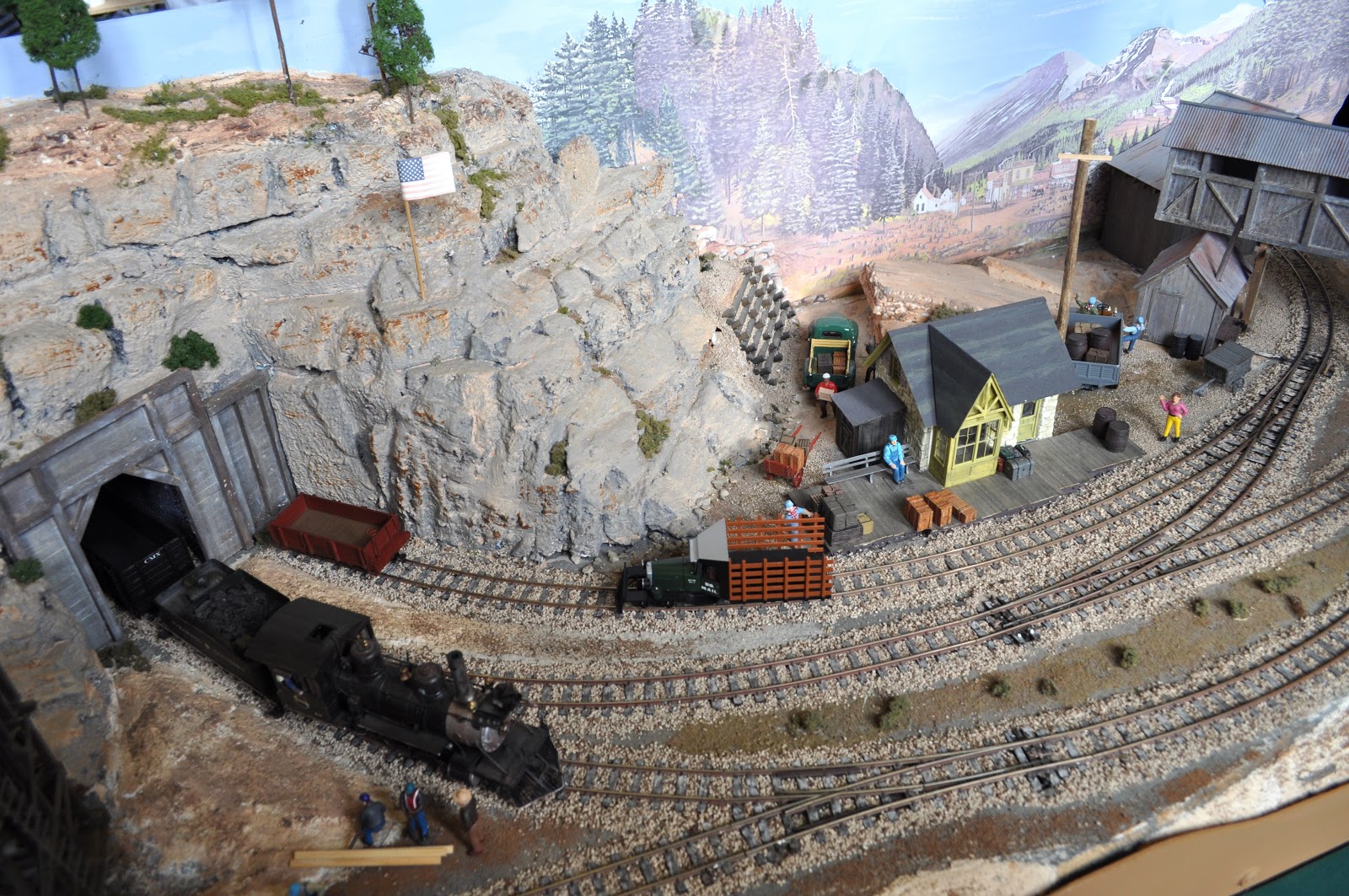
Next up in a scale wise 1/25 etc was the Yellow Ridge Uranium Mine. Lots of mining inspiration and a working ore tippler, although I caught the end of it working and then didn't catch it working again. Wanted to see how the trucks were held in place but suspect it is just some retaining rods.
Last up of the larger scale layouts that I took pictures of was the Schmalspur Workstadt Bahn. I didn't capture the RHB snow blower going round but I found this a useful indication of what could be done as a G scale layout, and was interested in the engine shed and the "double fairlie tram" - based upon an original in Saxony.
Then we come onto photos that are purely eye candy. I've had American leanings probably ever since I started this idea, probably only nipped in the bud to some extent by LGB not making much American stuff (at least not that was brand new) and especially not geared locomotives as in Shay, Heisler or Climax. Bachmann make them but an early forum post warned me of the dangers of running Bachmann Shays (10 or 18 volt, I suspect 10) on LGB 24 volt track power. End result very likely to be a puff of blue magic smoke. As always, with hindsight I should just have bought a shay when they were available somewhat cheaply and just had the innards replaced.
That brings me to Tuscora Mine. Unfinished as a result of the poor winter and round of viruses and bugs we have had. Long and thin, and almost a layout in two parts. This has the promise to be very interesting when finished.
And final photo was Gamle Carlesberg - literally "Old Carlesberg" but in reality a model of a view of the factory. I have been here (pre model railway days) and its a good trip from the centre of Oslo. Off to the far right is the famous elephant gate.
Like Grandma's secret cookie recipe, I was given an alternative to the (expensive, possibly overpriced) LGB Smoke Fluid. I have shared said recipe.
No guarantees it doesn't harm your smoke elements or damage your engines.
But I have shared it.
Your risk I felt amongst consenting adults.
Following a conversation tonight then CLEARLY YOUR RISK.
Will it burn your house down?
Probably, if you try, really, really, really hard (legally I suspect we are into Arson territory at this point) and set it up so it can burn your house down.
I thought I would test the questions about spills etc..
I was never one to shy away from practical chemistry....
My results (your tests may differ) into the mixture as quoted..(which form now on must remain one of those freemansonry type "not to be divulged" secrets.
Throwing matches into a pool of the secret mix... No fumes, no vapour, all a bit of a dud really...
This does however set me thinking about at what mixture is there fuel vapour/flammabillity A bit like saying "can I make napalm at home?". (I suspect pseudo Napalm might work better with BBQ gel rather than fluid).
So from here we progress to the "spill test" concept... Is it volatile ? And at what percentages ? I'm sorry that I don't have those answers to hand for you. Next weekend on the Iscatalbahn bomb range might have some answers for you. (Napalm per se is Petroleum Jelly with tweaks which set me wondering about BBQ lighter jelly...
Boys and Girls: DO NOT ATTEMPT THIS AT HOME
For the following tests I put a piece of kitchen paper into the bowl that had previously had the lit matches dropped directly into bare fluid... Stirred it around, ensured it was thoroughly soaked and then set light to it.
Iscatalbahn fire and rescue were on alert and had the pitcher of water to hand and the smothering (aka "deprive of oxygen" plate (and if you don't know how this works then go back to school).
A word of warning about water...
The water is to ensure no problems AFTER the fire is out, otherwise you might be into big burns territory... I have no idea if the patent mix is into this territory, but I'm finding out only outdoors..
Now:
a) I have yet to get the "secret recipe" burning without a base (e.g. impregnated tissue)
b I have yet then to pour water onto it.
(Away hopefully to a railway show on Saturday, but Sunday otherwise to play in the garden).
So, give it an impregnated tissue and set direct fire to the tissue and it will burn, and the tissue is a conduit/wick and appears to therefore burn fairly slowly...
So, where does this leave us ?
Well, back to the realm of common sense, except todays litigaticious society doesn't seem to start off with a concept of personal sense and responsibility.
Botched self install of a smoke unit and leaking fluid everywhere ? I dunno if an electrical spark would set that off, and again that is fresh territory.
I have filled locomotives "on the go"without flashback from eye dropper bottles. That is at my own risk and at the secret recipe mix. I suspect 100% BBQ lighter fluid will give you problems (least of all being no smoke).
"Hey, let's be careful out there."
And to see who is paying attention then let me know where the above quote comes from and I'll see what I can sort out as some sort of reward. Chris